

For most of the last two decades, a regional airline was treated as a place to build turbine time before escaping to a major airline. The pay was too low, the schedules were too difficult, and the difference between a regional career and a major-airline career was too large for most pilots to stop moving.
That calculation has changed.
A regional airline can now be a legitimate final career. It will not be the right choice for every pilot, and a major airline still has the greater lifetime earnings ceiling. But a regional captain with a strong seniority number, the right base and control over a monthly schedule can have a better life today than a junior first officer who starts over at the bottom of a major-airline seniority list.
The real question is no longer, “Why would anyone stay at a regional?” It is, “How much seniority and quality of life am I willing to trade for greater future income?”
Regional Pilot Pay Did Not Merely Improve. It Changed Categories.
The old numbers were worse than many pilots remember.
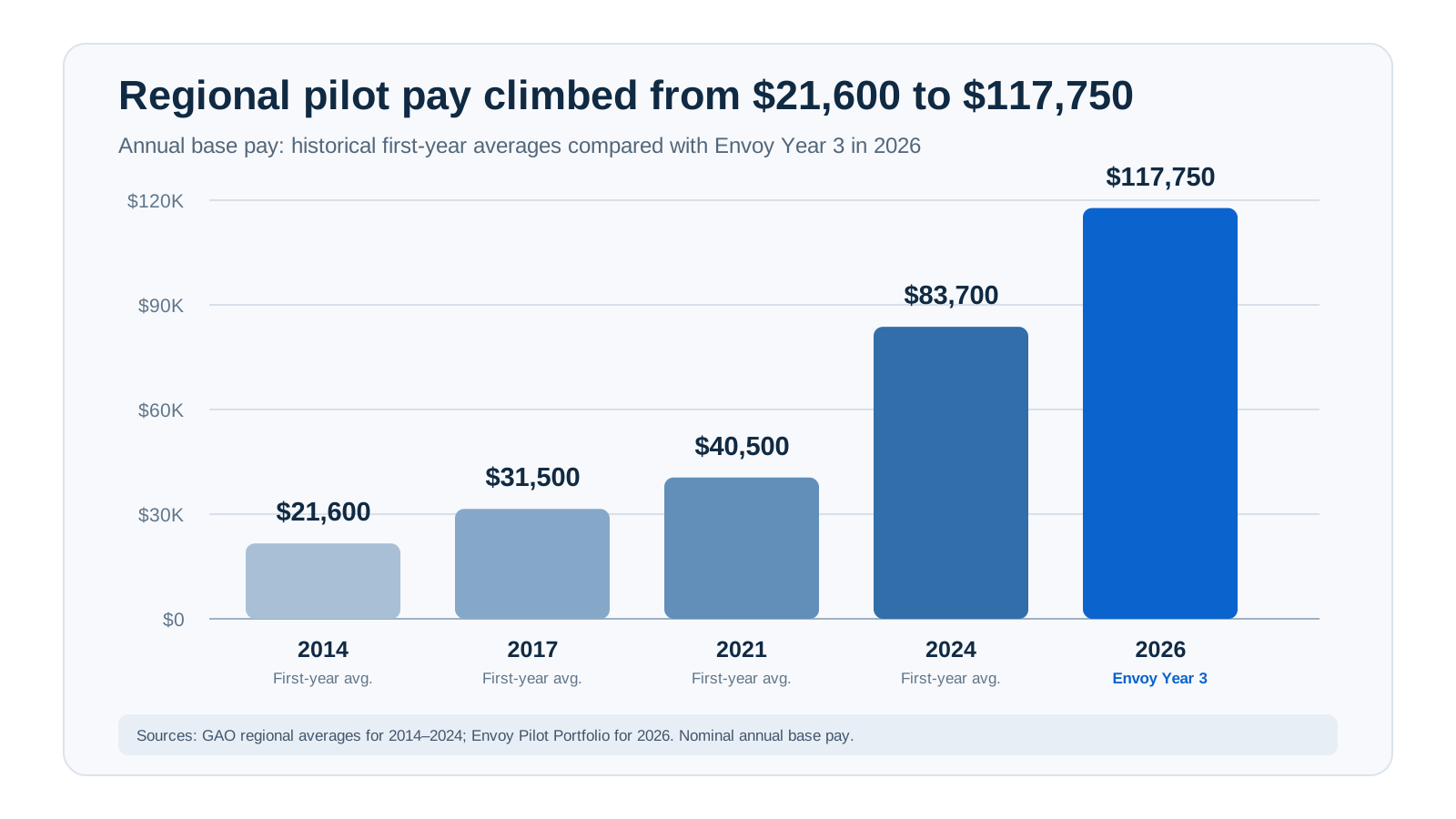
In 2014, the U.S. Government Accountability Office reviewed 14 regional airlines. At the common 75-credit monthly guarantee cited in the report, average first-year pay worked out to only $21,600 per year in base pay.
The annualized equivalent reached approximately $31,500 in 2017, $40,500 in 2021 and $83,700 in 2024. The latest industry-average figure comes from the GAO’s 2026 aviation-workforce report, which reviewed 12 selected regional airlines. For the current representative benchmark used throughout this article, Envoy’s 2026 third-year first officer scale annualizes to $117,750.
| Year | Benchmark | Annual base pay |
|---|---|---|
| 2014 | Regional first-year average | $21,600 |
| 2017 | Regional first-year average | $31,500 |
| 2021 | Regional first-year average | $40,500 |
| 2024 | Regional first-year average | $83,700 |
| 2026 | Envoy first officer, Year 3 | $117,750 |
The historical GAO series uses first-year pay because that is the consistent federal data available across the period. For a more representative current-career figure, this article uses third-year first officer pay as its general comparison. Envoy’s June 2026 Pilot Portfolio lists third-year first officer pay at $117.75 per credited hour, or $117,750 in annual base pay using the company’s own 1,000-credit annual estimate. Envoy adds an estimated $7,200 in per diem, producing a published estimate of $124,950, but the charts below keep per diem separate from cash salary.
Neither $83,700 nor $117,750 is a prediction of a pilot’s W-2. Airline pay is based on credited hours rather than a conventional 40-hour workweek. Additional flying, premium assignments, training pay, holiday pay, bonuses, profit sharing and other contractual compensation can push actual earnings higher. Per diem reimburses expenses associated with time away from base and should not be confused with salary.
Large regionals also advertise benefits that were once associated more strongly with destination airlines. Envoy lists health benefits, an American Airlines Group profit-sharing program, 401(k) matching and contractual work rules that include 12 days off per month. Exact medical costs, retirement formulas, vesting, work rules and disability coverage vary by airline and contract, so pilots should compare the complete package rather than annual base pay alone.
For perspective, the Bureau of Labor Statistics reported a $49,500 median wage for all U.S. occupations in 2024. The GAO regional first-year average, annualized at 75 credits per month, was roughly 69% higher.
Seniority Is the Currency That Buys Quality of Life
Airline pilots do not simply apply for the schedule they want. They bid, and their position on the seniority list largely determines what they can hold.
The Air Line Pilots Association says seniority improves a pilot’s pay, schedule and overall quality of life. Its aviation terms guide explains that monthly schedules are awarded in seniority order. Depending on the airline and its contract, seniority affects a pilot’s ability to hold:
- The desired domicile or crew base
- Captain or first officer status
- A particular aircraft
- A regular line instead of reserve
- Specific days off, trips, report times and overnight cities
- Vacation during popular weeks
- Extra flying that may pay at a premium
Longevity and seniority are related but are not identical. Longevity usually controls the applicable row of the pay scale. Seniority determines whether a pilot can hold the captain seat, aircraft and base that lead to a particular lifestyle.
Most importantly, seniority normally does not follow a pilot to another airline. A ten-year regional captain who accepts a major-airline job becomes the newest pilot on the new employer’s list. That pilot may receive a substantial long-term opportunity, but the immediate trade can include first-year pay, reserve, commuting, working holidays and much less control over trips.
Why Seniority Can Move Faster at a Regional Airline
Regional airlines have historically lost experienced pilots to larger airlines. Every departure moves the pilots below that person one number higher. Growth, retirements and new aircraft can create additional movement.
Major-airline lists move too. The current wave of retirements and continued fleet growth are meaningful, as explained in our airline pilot hiring outlook. The difference is that a pilot who reaches a major airline has usually reached the destination. There is less routine attrition to another level of airline above it, so movement depends more heavily on retirements, growth, fleet changes and hiring below the pilot.
That is why a regional pilot may be able to:
- Upgrade to captain sooner
- Hold a preferred base sooner
- Get off reserve sooner
- Hold weekends, holidays or specific trip types sooner
- Build a schedule around family needs sooner
None of those outcomes is guaranteed. Regional movement can reverse when a carrier loses flying, closes a base, parks a fleet, stops hiring or furloughs.
Regional Captain, Check Airman or American First Officer?
Comparing a major-airline captain with a regional first officer produces an obvious answer but not a useful career decision. A more realistic progression is regional first officer → regional captain → check airman, compared with leaving for a major airline, resetting seniority and reaching third-year first officer pay.
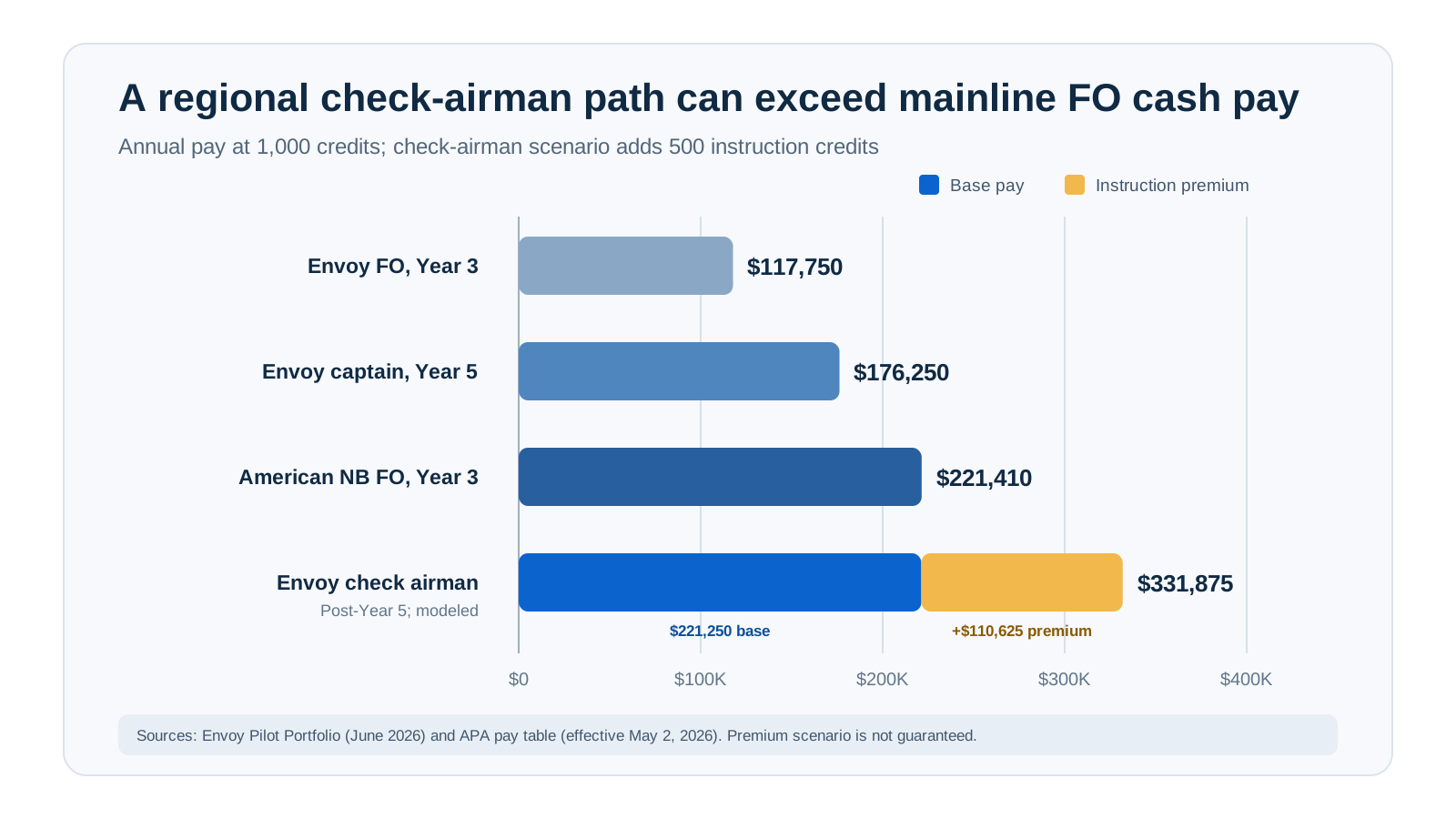
The following chart uses Envoy’s official June 2026 pay tables and the narrowbody first officer table in the Allied Pilots Association’s contract summary, effective May 2, 2026. Every base-pay figure uses 1,000 annual credits, matching Envoy’s published annual estimates. The check-airman bar is a transparent scenario—not a guaranteed salary—that adds 500 actual instruction credits to the Step 20 captain base.
| Career position | Annual cash-pay basis |
|---|---|
| Envoy first officer, Year 3 | $117,750 base |
| Envoy captain, Year 5 | $176,250 base |
| American 737/A320-family first officer, Year 3 | $221,410 base |
| Envoy check airman after Year 5 | $221,250 Step 20 base |
| Envoy check airman with 500 instruction credits | $331,875 modeled total |
A standard fifth-year Envoy captain earns $45,160 less in annualized base pay than a third-year American narrowbody first officer. That is the honest apples-to-apples result. The stronger regional comparison appears after a pilot qualifies for and is selected into a check-airman position.
Why the Check-Airman Path Changes the Comparison
A line or IOE check airman trains and evaluates pilots during operating experience. Envoy’s portfolio says a pilot who has completed the fifth year and is working as a Line (IOE) Check Airman, Proficiency Check Airman or Aircrew Program Designee is paid the Step 20 captain rate while in that position. At the current $221.25 rate and 1,000 annual credits, that is $221,250 in base pay—only $160 below the annualized base pay of the American third-year narrowbody first officer.
Envoy then pays a Line (IOE) Check Airman a premium equal to 100% of the hourly rate for each flight hour of instruction. That makes the current rate $442.50 per instruction credit: $221.25 of ordinary pay plus a matching $221.25 premium. Because Envoy does not publish a typical annual allocation of instruction credits, the defensible way to show the opportunity is as a range:
| Instruction credits within 1,000 total annual credits | Estimated annual cash pay |
|---|---|
| 0 | $221,250 |
| 250 | $276,563 |
| 500 | $331,875 |
| 750 | $387,188 |
| 1,000 | $442,500 |
The formula is straightforward: $221,250 base + ($221.25 × instruction credits). The 500-credit example in the chart is a scenario, not a company projection or a typical-pay claim. Actual instruction time can be much lower, and the role itself is not automatic. Selection depends on qualifications, performance, seniority, training demand and available positions. Envoy also states that the current 50% Pilot Supply Premium—and therefore the displayed rates—runs through December 31, 2026 unless extended or replaced.
This is what makes staying at a regional even more of a credible final-career strategy. A pilot can retain the seniority already earned, upgrade to captain and potentially move into a training role whose base pay nearly matches a third-year American first officer before the instruction premium begins. The fifth-year captain rate alone does not beat American’s third-year FO rate; the check-airman opportunity is what changes the cash-pay comparison.
It still does not prove that the regional job has greater lifetime value. American’s agreement provides an 18% non-elective retirement contribution effective May 2, 2026—about $39,854 on $221,410 of eligible base earnings—while Envoy lists a maximum company 401(k) match of 5.25% during years five through nine. Retirement money is not current cash salary, and eligibility rules matter, but the difference is material. American also retains the greater long-term earnings ceiling, particularly for pilots with enough career remaining to gain seniority and upgrade.
The regional pilot may still have the better life in the near term. A senior captain or check airman who lives in base and holds desired days and trips might reasonably prefer that job to resetting seniority, commuting, sitting reserve or missing holidays at a major airline. Another pilot may gladly accept the reset for decades of greater future earnings.
The Old Regional-Airline Career Was a Very Different Life
My father’s career is a useful picture of what the old path demanded.
He instructed for eight years. He then spent four years flying turboprops for a small regional cargo carrier at only $17 per flight hour. When he finally reached a passenger regional airline, his $19 starting rate worked out to only about $17,000 on the same basis. He remembers new pilots being warned not to use food stamps while wearing the uniform. Today, he flies for JetBlue.
That path required roughly 12 years of professional flying before even reaching the low-paid regional job that was supposed to begin the airline career. Many pilots from that era endured years of poverty-level pay because the regional airline was the bridge to a career that could eventually support a family.
Today’s pilot still has to earn certificates, build experience, qualify for an ATP and pass demanding airline training. Hiring is cyclical, and reaching 1,500 hours does not guarantee an immediate class date. But once hired at a regional, the pilot can begin with base-equivalent pay that greatly exceeds the median U.S. occupation. That changes the downside of the entire career path: the first Part 121 airline job can now be a respectable destination.
Who Should Seriously Consider Staying Regional?
There is no universal cutoff, but time horizon changes the answer.
| Career situation | Regional airline may be the better fit when… | Major airline may be the better fit when… |
|---|---|---|
| Pilot begins airline career around age 23 | A specific regional base or family need outweighs maximum lifetime earnings | The pilot wants the highest long-term ceiling and has roughly 42 years before age 65 |
| Pilot begins airline career around age 55 | Rapid access to a local base, captain seat and schedule control matters more than starting over | A major-airline opportunity arrives early enough, in the right base, to justify the reset over the remaining career |
| Pilot already has strong regional seniority | The pilot can hold captain, a good line and desired holidays | Long-term compensation and retirement gains outweigh losing the existing seniority number |
| Pilot would commute to the major | The regional job is in base and produces more usable time at home | The commute is temporary or the pilot can soon move to the major-airline base |
| Pilot values predictability | Current seniority produces a stable, repeatable schedule | The pilot can tolerate reserve and uncertainty while seniority improves |
A 23-year-old who wants a major-airline career will usually have a powerful reason to continue. Even a few difficult junior years can be small compared with four decades of higher earning potential.
A 55-year-old entering the industry has, at most, about 15 years before the current Part 121 retirement age of 65. That pilot may place much more value on becoming a regional captain, living in base and gaining schedule control without resetting seniority again. The correct choice depends on how long training and time-building take, when the airline hires, upgrade timing, base availability and family priorities. Age alone does not decide it.
The Risks Have Not Disappeared
A regional airline is now financially capable of being a career. It is not guaranteed to remain the same career for 20 years.
Regional flying often depends on contracts with larger airline partners and on exceptions within mainline scope clauses. Flying can move between carriers. Bases can open and close. Aircraft can be reassigned or parked. Airlines can merge, restructure or furlough. A pilot who builds a plan around one exact upgrade time or base award is assuming more certainty than the industry can provide.
Before choosing an airline, compare more than the first-year annual base-pay figure:
- Base: Can you live where you are based, or will every trip require an unpaid commute?
- Seniority: How many pilots are above you in the exact seat, fleet and base you want?
- Fleet and partner risk: Is the carrier growing, and how concentrated is its flying?
- Contract and work rules: What are the reserve rules, minimum days off, deadhead pay, cancellation protection and premium-pay provisions?
- Retirement and insurance: What does the company contribute, when does it vest, and what protection exists if you lose your medical?
- Upgrade reality: Are eligible first officers actually upgrading and flying, or is the advertised timeline theoretical?
- Your exit options: If the airline changes, would you still be willing and competitive to move?
The Bottom Line
Regional airlines used to offer a long apprenticeship at wages that were difficult to live on. For most pilots, moving on was less a preference than a financial necessity.
That is no longer true.
The major-airline path still wins if the goal is maximum lifetime compensation. The regional path can win if the goal is to become a captain sooner, live in the desired base, hold better trips, protect holidays and spend more usable time with family. Seniority turns those preferences into a schedule, and leaving for a major means giving that seniority up.
For the first time in modern U.S. airline history, a pilot can reach the first Part 121 airline job and reasonably decide, “This is enough. I can build a good life here.” That makes the entire airline career more resilient, even for pilots who never reach a legacy-airline captain seat.
If you are still evaluating the path, start with the complete steps to become an airline pilot, review what pilot training actually costs, or take our Can I Be a Pilot? quiz.
Research sources and chart methodology
- GAO-14-232: Aviation Workforce, Current and Future Availability of Airline Pilots, especially pages 30–31 for the 2014 regional pay average, 75-hour guarantee convention and historical upgrade discussion.
- GAO-23-106769: Aviation Workforce, Supply of Airline Pilots and Aircraft Mechanics, especially page 8 for 2017 and 2021 first-year regional pay.
- GAO-26-107856: Aviation Workforce, especially the regional pay analysis and Figure 2 for the 2024 average.
- Envoy Pilot Portfolio, June 2026, especially pages 7–8 for third-year first officer pay, fifth-year captain pay, Step 20 check-airman pay, the 100% instruction premium and the December 31, 2026 Pilot Supply Premium term.
- Envoy pilot careers for current pilot benefits and work-rule highlights.
- Allied Pilots Association 2023 Tentative Agreement Executive Summary, Appendix B page 38 for the American Airlines third-year narrowbody first officer rate effective May 2, 2026, and the compensation section for the 18% non-elective retirement contribution.
- ALPA’s Top Reasons to Become an Airline Pilot and Aviation Terms for seniority, schedule bidding and common monthly guarantees.
- FAA legal interpretation of 14 C.F.R. § 121.436 for qualifying air-carrier experience required before serving as a Part 121 captain.
- BLS Occupational Outlook Handbook: Airline and Commercial Pilots for national wage and career context.
Current-career annual base-pay equivalents use 1,000 credits, matching Envoy’s published annual-pay methodology. The underlying rates are $117.75 for the Envoy third-year first officer, $176.25 for the Envoy fifth-year captain, $221.41 for the American third-year 737/A320-family first officer and $221.25 for the eligible post-fifth-year Envoy check airman. The check-airman examples add a $221.25 premium for each assumed instruction credit.
These examples are scenarios, not guaranteed or typical compensation; the role, total credits and instruction assignments vary. The historical GAO chart separately uses the reports’ 75-credit monthly convention, and its nominal values are not adjusted for inflation. Pay tables, premiums and collective bargaining agreements can change after publication.