
Airline pilot hiring has slowed from the historic surge of 2022 and 2023. Flight instructors are building more time before getting interviews, regional airlines can be more selective, and some pilots who reached 1,500 hours have discovered that meeting the hour requirement does not guarantee an immediate airline class date.
That sounds concerning if you only look at the market today. It looks very different when you look at the full hiring cycle.
The United States does not have one universal pilot shortage or pilot surplus. It has a timing and experience mismatch. In 2026, much of the congestion is concentrated among new flight instructors and low-time pilots. At the same time, airlines continue to hire thousands of pilots, and Boeing and Airbus are working through enormous aircraft backlogs.
The short answer is that this is a hiring lull, not the end of the airline pilot career. In many ways, a slower period can be one of the better times to begin training because a new student will not enter the job market for several years.
No flight school can promise exactly when an airline will hire you. You should begin because you want to learn the craft, can make the investment responsibly, and are prepared to become a strong pilot rather than simply collect certificates.
Airline Pilot Jobs and Hiring Have Always Been Cyclical
The best evidence comes from FAPA’s Major Airline Pilot Hiring History, which tracks hiring at selected U.S. major and national airlines. The list includes passenger and cargo carriers, but it does not include regional airlines or most charter, corporate, fractional and other commercial operators. FAPA also warns that its method may double-count up to 15% of reported hires when pilots move from one tracked airline to another.
The cycles are still unmistakable.
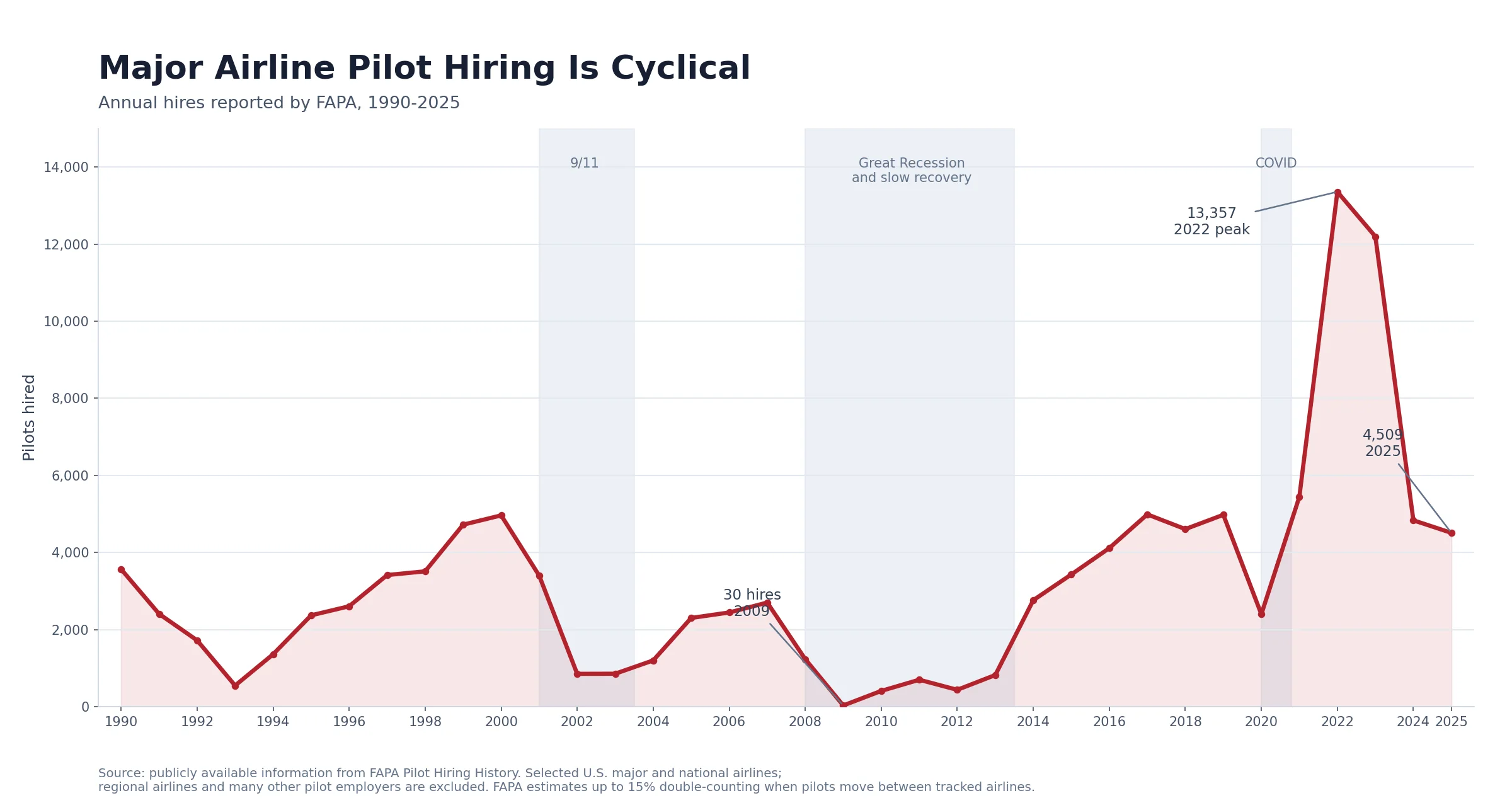
FAPA reports that the tracked airlines hired 2,700 pilots in 2007. Hiring fell to 1,232 in 2008 and then to just 30 in 2009 during the Great Recession. Hiring remained below 1,000 per year through 2013 before jumping to 2,762 in 2014 and approaching 5,000 by 2017.
The same pattern appeared after 9/11 and again during COVID. The difference today is that the current slowdown is nowhere close to those collapses:
| Year | Pilots hired by FAPA-tracked airlines |
|---|---|
| 2009 | 30 |
| 2013 | 820 |
| 2019 | 4,977 |
| 2020 | 2,398 |
| 2022 | 13,357 |
| 2023 | 12,196 |
| 2024 | 4,834 |
| 2025 | 4,509 |
| 2026 through July | 3,863 |
If the 2026 pace continued evenly, the year would finish at roughly 6,600 hires. Hiring never moves perfectly evenly, so that should not be treated as a forecast. It does show why it is misleading to compare every year to the unprecedented 2022 and 2023 surge.
The industry is in a lull relative to the largest hiring boom in its history. It is not in another 2009.
Why Flight Instructors Are Getting Stuck
When major airlines slow hiring, the effect moves down the entire career ladder.
Major airlines take experienced pilots from low-cost carriers, cargo operators, regional airlines, military flying and other commercial operations. Regional airlines then lose captains and experienced first officers. Flight schools lose instructors to regional, charter and cargo jobs. When hiring accelerates, movement at the top opens positions throughout the industry.
When major hiring slows, that movement stops. Regional captains remain at their airline longer. First officers upgrade more slowly. Regionals need fewer new first officers, and CFIs accumulate at the bottom of the pipeline.
The FAA’s 2025 airmen statistics show the pressure building. The FAA issued 12,961 initial flight instructor certificates in 2025, up from 8,364 in 2022. Initial ATP certificates, meanwhile, fell from 11,218 in 2023 to 7,714 in 2025.
From 2023 through 2025, the FAA issued:
- 35,742 initial CFI certificates
- 28,445 initial ATP certificates
Those are not the same people moving through a clean three-year funnel. Some ATP candidates never instructed, some CFIs do not want an airline career, and it normally takes years to move from CFI to ATP. The 7,297-certificate difference is therefore not a count of unemployed instructors or people who quit.
It is still a strong sign that new instructor production has been outrunning the next stage of the pipeline.
Some Pilots Will Leave Before Hiring Accelerates Again
There is no national database that tracks how many flight instructors abandon professional aviation between 250 and 1,500 hours. We should be honest about that.
There are good reasons to believe attrition is happening, however. Many large career programs now cost well over $100,000. AOPA reported in 2025 that airline-career programs commonly exceed that amount, while private aviation loans can finance up to the full cost of training.
Some schools sold students on an extremely simple expectation: finish quickly, instruct to 1,500 hours, and immediately enter an airline class. When hiring slowed, students carrying six-figure loans discovered an additional waiting period they had not included in their financial plan.
That group will probably split into several categories:
- Some will remain in aviation and keep building experience until the right position opens.
- Some will take non-airline flying jobs in charter, cargo, corporate, survey, medevac, government or other operations.
- Some will work outside aviation temporarily and return when hiring improves.
- Some will leave professional flying permanently because their loan payments and living expenses do not allow them to wait.
If 15% to 25% of the 35,742 people who earned initial CFI certificates from 2023 through 2025 permanently left the airline path or became delayed for many years, that would remove approximately 5,400 to 8,900 pilots from that recent pipeline.
That is a planning scenario, not a measured national dropout statistic. Even so, it demonstrates how an apparent oversupply can shrink before airlines begin another strong hiring cycle.
Over the years, I have personally met pilots who walked away after 9/11, during the 2008 recession and at the beginning of COVID. Some never returned. At each low point, people reasonably believed the opportunities were gone. Then the cycle turned again.
Certified Does Not Always Mean Competitive
Another group will continue flying but repeatedly watch peers get hired first.
Passing an FAA checkride means a pilot met the applicable standard on that day. It does not mean every certificated pilot has the same depth of knowledge, judgment, communication skills, professionalism or ability to succeed in airline training.
We see this directly at Pilot Rise. In 2020 and 2021, before the hiring boom, we sometimes received very few applications for an instructor position, but most applicants were reasonably strong. Today, a CFI opening can attract more than 100 applicants, many from outside Texas.
Before applicants even reach the formal interview, we use screening questions and a short phone conversation. More than half often do not meet our standards. That can become clear through weak technical knowledge, poor preparation, an inability to explain basic concepts, careless application answers or communication that does not fit a teaching and customer-facing position.
This is an observation from one growing flight school, not a national scientific study. It is nevertheless the same basic effect that occurs at airlines when they have more qualified applicants than available seats: meeting the legal minimum gets someone into the applicant pool, but it does not move that person to the top.
I also know a pilot who met the formal qualifications for a regional airline position but had repeatedly looked for shortcuts during training. The airline hired him, but he was not proficient, had not developed strong study habits and lacked the meaningful experience he needed to succeed in initial training. He failed out of the airline’s training program and chose a different career as an aircraft mechanic.
One pilot does not represent an industry. His experience does illustrate the difference between meeting the qualifications for a job and being prepared to perform at the required standard.
This is one reason we started Pilot Rise. The goal was never to push people through a checkride as quickly as possible and send them away. It was to build pilots who could handle the next certificate, the next airplane, professional training and the responsibility of carrying passengers.
Not just certified. Ready.
More Than 20,000 Big Four Retirements Are Approaching
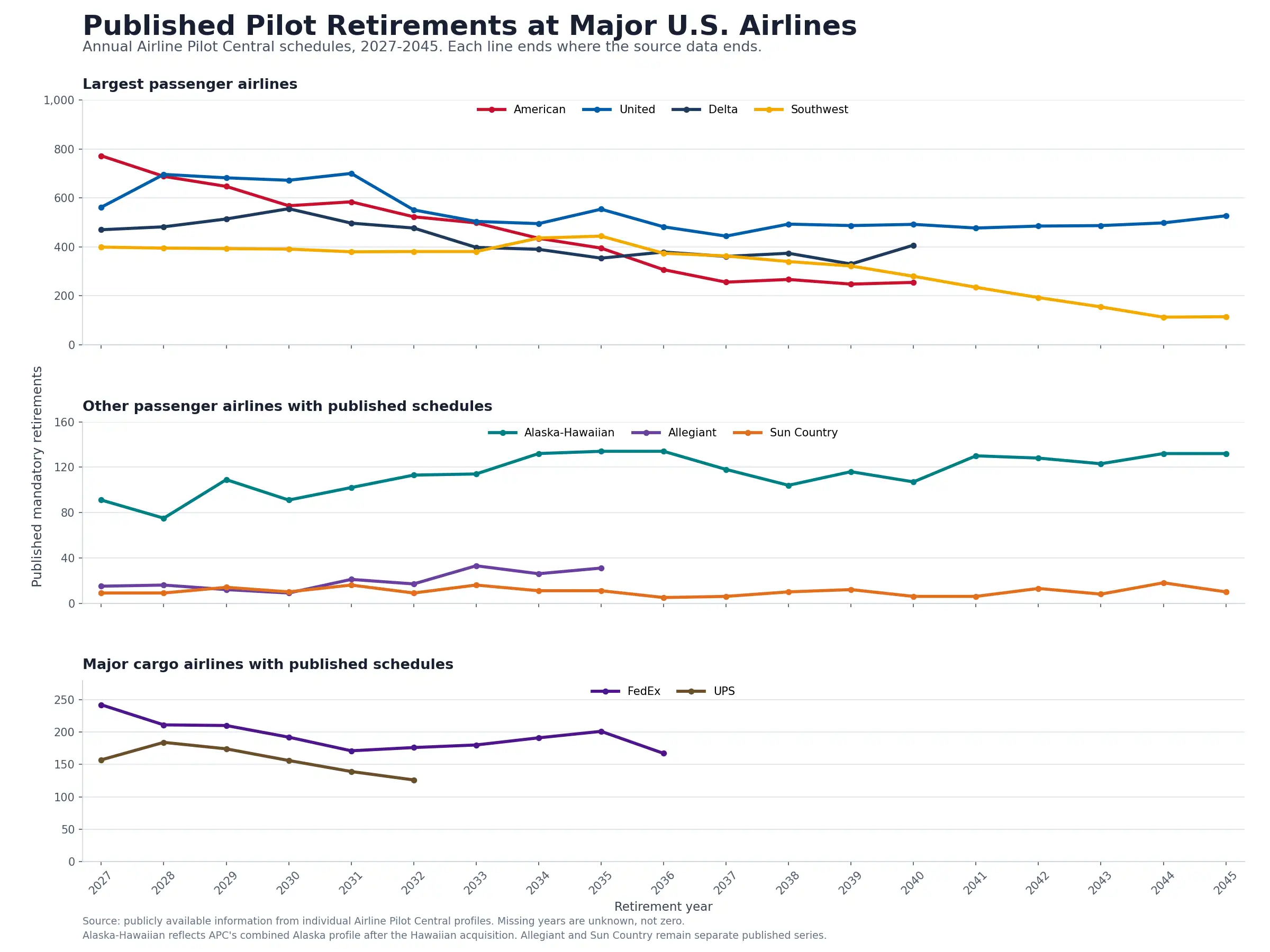
The current FAA mandatory retirement age for Part 121 airline pilots remains 65. Airline Pilot Central publishes retirement estimates based on pilots reaching that age. These are third-party estimates rather than airline financial guidance, and they could change if retirement law changes or the underlying seniority data is revised.
This figure is deliberately narrow. It includes only American, Delta, United and Southwest, the four largest U.S. passenger airlines. It does not include retirements or growth at cargo carriers, regional airlines, corporate flight departments, fractional operators, charter companies, FAA and other government flight positions, medevac operators or the many other employers that hire professional pilots. Corporate aviation alone is a large employment market that is not represented in this total.
Using the currently published schedules, the four largest U.S. passenger airlines face approximately 20,600 mandatory retirements from 2026 through 2035:
| Airline | Estimated retirements, 2026-2035 |
|---|---|
| American Airlines | 6,014 |
| Delta Air Lines | 4,659 |
| United Airlines | 5,921* |
| Southwest Airlines | 3,978 |
| Approximate total | 20,572 |
United’s 2026 figure is listed as 505 retirements remaining in 2026, followed by full-year estimates for 2027 through 2035.
American’s retirements have started declining from their peak, and Delta’s remain relatively steady. United rises into the late 2020s and early 2030s. Southwest increases from 206 retirements in 2021 to approximately 400 per year during much of the coming decade, reaching 444 in 2035.
Those retirements do not guarantee 20,600 one-for-one new-hire positions. Airlines can reduce schedules, change aircraft size, improve utilization or shrink during a recession. But retirements create a persistent replacement need before the airlines add a single new airplane.
Every other aviation segment also has its own replacement and growth needs. Regional-airline demand, for example, is driven by retirements, expansion and captains leaving for larger carriers. The GAO’s 2026 regional airline workforce report found that the post-COVID regional shortage was primarily a captain problem: regionals could find first officers, but experienced captains were moving to mainline airlines faster than replacements could upgrade.
That matters because the next major-airline hiring increase will again create vacancies below it.
A Regional Airline Can Be a Good Long-Term Career
Regional airlines used to be associated with extremely low first-year pay and years spent trying to escape to a major. Around 2020, a regional first officer might earn roughly $40,000 per year. Regional pay increased sharply after the pandemic, and published 2026 pay scales now place many established regional captains around $160,000 to $185,000 per year. After first-year probationary pay, many regional first officers earn roughly $110,000 to $130,000 per year, depending on the airline, contract, schedule and additional compensation.
The good news is that a regional airline no longer has to be only a stepping stone. It can be a meaningful long-term career. Some pilots choose to stay because living in base can eliminate a commute, protect a good schedule and provide a better quality of life. Others will still move to a major airline for higher long-term earning potential, larger aircraft or international flying. Both can be successful careers.
Aircraft Deliveries Support Expansion
Aircraft orders are another reason for a positive long-term outlook.
As of June 2026, Airbus reported a backlog of 9,222 aircraft. Boeing reported more than 6,200 aircraft in backlog. Both manufacturers delivered more aircraft during the first half of 2026 than during the same period in 2025.
Those are worldwide backlogs, and not every delivery creates a new pilot position. Some aircraft replace older airplanes, some orders may be deferred, and production will increase gradually rather than all at once.
When an aircraft is a net addition to an airline’s active fleet, however, it requires far more than one captain and one first officer. Across selected large airlines, a published fleet and staffing comparison averages roughly 18 to 20 pilots per aircraft. A short-haul aircraft may require fewer, while an intensively used long-haul fleet with augmented crews, reserves, training and leave coverage can require 20 to 30 pilots per aircraft.
That means a net addition of 100 aircraft can reasonably support roughly 1,500 to 3,000 pilot positions, depending on the airline, aircraft, schedule and utilization. Fleet growth is powerful because it adds staffing demand on top of retirements.
Boeing’s 2026 Pilot and Technician Outlook projects that the worldwide commercial aviation system will need 674,000 new pilots through 2045. That is a global, long-range forecast rather than a promise about U.S. hiring in any one year, but it reinforces the scale of the structural demand.
Airlines Cannot Rely on Military Pilots Like They Once Did
Military aviators remain excellent and highly competitive airline candidates, but they are a much smaller share of the supply than they were several decades ago.
A GAO review of pilot training found that, until the 1990s, roughly 90% of pilots hired by mainline airlines came from the military. By 2008, approximately 30% of commercial-airline hires had military training backgrounds. The GAO also noted that the military was training fewer pilots and using retention incentives to keep more of them.
That shift is important for civilian students. The airlines still value military experience, but the civilian route is now the normal path for most new professional pilots. Airlines cannot fill the next decade of retirements and expansion entirely from a limited military supply.
High Fuel Prices May Extend the Lull
The current fuel shock did not cause the original 2024 and 2025 slowdown. Airlines were already normalizing after two extraordinary hiring years, and Boeing and Airbus delivery delays were limiting planned growth.
Fuel is now another meaningful restraint.
Following the closure of the Strait of Hormuz, the U.S. Energy Information Administration reported that Gulf Coast jet fuel averaged $3.91 per gallon from March through May 2026, approximately twice its price at the beginning of the year. IATA reduced its forecast for 2026 global airline profit from $41 billion to $23 billion because of the disruption and fuel increase.
Airlines do not know how long the conflict or high prices will last. That uncertainty can cause them to delay aggressive growth, protect cash and wait before committing to the fastest hiring plan.
The fuel spike also created an immediate shock to the pilot job market. Spirit Airlines ceased operations on May 2, 2026. Spirit had already been working through a second bankruptcy and other financial pressures, but the company said the sudden and sustained rise in fuel prices left it with no alternative but to wind down.
That shutdown put a large group of highly qualified and experienced Spirit pilots into the job market at the same time. Their arrival is one of the biggest short-term factors slowing movement for pilots with less experience.
The aircraft do not immediately create replacement jobs elsewhere. Most must first be returned to lessors, inspected, transitioned and then sold or leased to another operator. KBRA expects a period of downtime while Spirit’s aircraft go through repossession and transition. As those airplanes return to service with other airlines, some jobs can return with them, but that process takes time.
Fuel may therefore extend the current lull. It does not erase the retirements, aircraft orders or long-term need for pilots. If fuel conditions stabilize, some deferred growth can return relatively quickly.
Passenger Airlines Are Only Part of the Pilot Job Market
The major passenger airlines receive most of the attention, but professional pilots work throughout aviation:
- Regional passenger airlines
- Major and feeder cargo carriers
- Part 135 charter operators
- Fractional aircraft companies
- Corporate flight departments
- Medevac and organ-transport operations
- Aerial survey and mapping
- Fire patrol, pipeline patrol and utility flying
- Government and law-enforcement aviation
- Aircraft manufacturers and flight-test operations
- Flight schools and university programs
FAPA’s hiring history includes FedEx, UPS and Atlas in applicable years, but it still excludes many of these employers. The actual pilot job market is much larger than the graph.
Some positions provide a path to a passenger airline. Others can become rewarding careers of their own.
The Bureau of Labor Statistics projects about 18,200 openings per year for airline and commercial pilots combined over the 2024-2034 period. Most are expected to come from retirements and people leaving the occupation rather than pure employment growth. Those openings cover a broader market than entry-level airline seats, which is exactly the point: professional flying is not one job at one type of airline.
Why Starting During a Slow Period Can Make Sense
A person beginning at zero flight time today is not competing for a regional airline class tomorrow.
Depending on schedule, weather, checkride availability and individual progress, completing Private, Instrument, Commercial, CFI and CFII training can take approximately 9 to 24 months. Building the remaining experience for an unrestricted ATP can take another 16 to 24 months at a consistent flying job. Someone starting in 2026 may not become airline-eligible until 2029 or 2030.
That timing is why starting in a slower period can be an advantage.
Someone who begins during a record hiring boom may finish training just as the boom ends. Someone who begins during a lull may complete training as retirements, aircraft deliveries and airline movement accelerate again.
There is no guarantee. A recession, another war, airline failure, medical problem, production delay or regulatory change can alter any forecast. Flight training should never be sold as “guaranteed to the airlines in under two years.”
It is still reasonable to be optimistic. The next decade includes substantial mandatory retirements, a smaller military pipeline than past generations, large aircraft backlogs and employment opportunities far beyond the largest passenger airlines. Even the current lull has produced more than 4,000 annual hires at FAPA-tracked airlines, compared with only 30 in 2009.
In Today’s Market, You Need to Stand Out
During the peak of the hiring boom, it sometimes appeared that 1,500 hours and a pulse were enough. That was never the standard airlines wanted, and it is not today’s market.
Airlines are looking for pilots who can complete training, work well with a crew and represent the company around passengers. Flight time and certificates matter, but so do:
- Strong technical knowledge and aircraft control
- Good judgment and a conservative safety mindset
- Honest, complete and accurate applications
- Customer service and communication skills
- Leadership, teaching and mentoring experience
- A strong training and employment record
- Recent flying and continued proficiency
- Professional recommendations from people who know your work
- Preparation for technical and behavioral interviews
- The maturity to accept feedback and improve
A college degree is not required at every airline. Becoming a CFI is not the only way to build hours. Attending hiring events, volunteering and making professional connections are not mandatory either.
But candidates who take those extra steps frequently move ahead of peers who only meet the minimums. A degree may strengthen an application or provide a backup career. Pilot Rise students can review our college credit and degree pathways for FAA pilot certificates without delaying all flight training until after graduation.
Hiring events provide face time and current recruiter feedback. Working at an airport builds relationships. Volunteer and leadership work can demonstrate character. A genuine recommendation from someone who has flown or worked with you is more valuable than collecting names from strangers.
The goal is not to pad a résumé. It is to become the kind of pilot an instructor, chief pilot, check airman or captain would want beside them.
Train for the Career, Not Only the Checkride
The long-term airline outlook remains positive, particularly when compared with the disruptions and hiring collapses of the previous three decades. That does not mean every month will be easy or that every pilot will reach the same destination on the same schedule.
If you are considering flight training, build a plan that remains financially workable if the first airline job takes longer than expected. Compare real prices, avoid borrowing based on a guaranteed hiring date, and choose a school focused on proficiency rather than the fastest possible certificate.
Pilot Rise publishes a detailed 2026 flight training cost guide so students can see realistic ranges and where the money goes. We also provide active students access to an FAA-approved training device without an hourly device charge. That allows students to practice procedures, instruments, radio work and emergencies without paying aircraft rental for every repetition.
If you are still deciding whether flying fits you, take our free Can I Be a Pilot? readiness quiz. It looks at several skills and habits that support training, including judgment, communication, memory, spatial thinking and study readiness. It is not an employment test or guarantee, but it can help identify a practical starting point.
The airline career remains one of the most rewarding careers available. The airplanes, travel and compensation are all part of it, but they should not be the only reason to begin. Learn to enjoy the craft, take pride in doing things correctly, and build the knowledge and character that will carry you through both the hiring booms and the slow periods.
The market will change. Strong pilots will still be needed.
Not just certified. Ready.
Research Notes and Sources
- FAPA Major Airline Pilot Hiring History
- FAA U.S. Civil Airmen Statistics
- GAO: Information on Pilot Supply and Regional Airlines
- GAO: Initial Pilot Training
- Boeing Pilot and Technician Outlook
- Bureau of Labor Statistics: Airline and Commercial Pilots
- Airbus H1 2026 Results
- Boeing Q2 2026 Results
- EIA Jet Fuel Market Update
- IATA 2026 Fuel and Profitability Update
- Spirit Airlines Wind-Down Announcement
- KBRA: Spirit Aircraft Repossession and Transition
- Airline Pilot Central Airline Profiles